How Korean Market Shocks Keep Catching Global Traders Off Guard
April 2, 2026
A Market-Moving Event Just Happened That Most Global Traders Are Underweighting
On March 15, South Korean financial regulators placed a six-month partial suspension on Bithumb, the country's second-largest crypto exchange. English-language coverage treated it as a straightforward compliance story about AML enforcement and regulatory housekeeping. But most of that coverage missed the more important story.
In practice, this is unfolding as a market structure event inside one of the deepest fiat-backed liquidity pools in onchain finance, with implications that extend well beyond Korea itself. Upbit and Bithumb together handle roughly 96% of Korean crypto trading volume, and the Bithumb suspension is not just reshaping domestic market dynamics. It’s eroding the quality of signals this market has been sending to global traders for years.
All of which is to say, Korean crypto users are highly active but operate within a system shaped by capital controls, exchange concentration, and a persistent language barrier. That combination means price-relevant information often appears locally before it is reflected globally, creating short windows where markets fall out of sync.
The Reason Global Traders Are Late to the News Is Structural, Not Incidental
Far from being a peripheral market, Korea is one of the most instructive markets in the world for understanding where onchain opportunities originate. The Korean won is the second most-traded fiat currency in crypto globally, accounting for roughly $663 billion in volume year-to-date and close to 30% of all fiat-to-crypto activity worldwide. Nearly one in three Korean adults holds digital assets, double the rate in the United States.
Korea's current administration was elected in June 2025 on one of the most explicitly pro-crypto platforms in political history. Nearly half of the top 30 performing KOSPI stocks since his inauguration are tied to digital assets. The equity market absorbed this signal quickly, though the vast majority of the crypto community did not.
This was not a one-off market dislocation. Korean political and regulatory developments regularly surface first in Korean-language media and local CT, move KRW pairs on Upbit and Bithumb, and reach English-language coverage hours to days later. The same dynamic plays out in reverse: global macro shifts that originate in English-language markets often take time to be priced into local pairs. By the time the translation happens, the initial price response has usually already occurred.
The clearest documented example came on December 3, 2024, when President Yoon declared martial law. Korean BTC prices dropped roughly 30% intraday while global prices fell around 2% — a 28-point divergence driven entirely by a domestic political shock. The sell-off totaled roughly $33.3 billion, and the local market briefly recorded the highest trading volume globally.
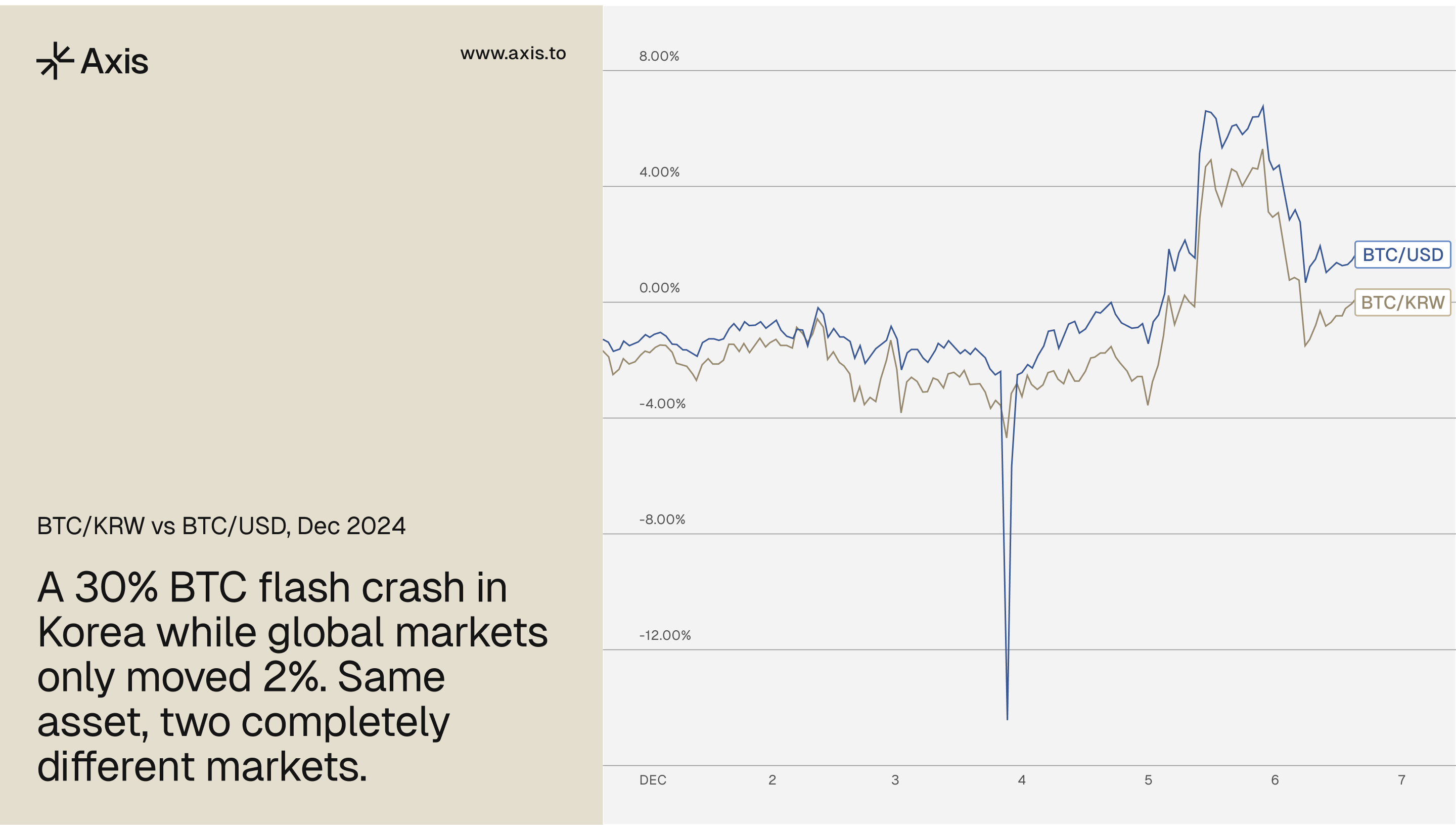
This event was a classic example in how Korean market dislocations often unfold. Bid-side liquidity thinned immediately while offer-side pressure stacked up, with the sell pressure concentrated entirely in KRW pairs. Even stablecoins depegged, with USDT trading as low as 75 cents on the dollar on Korean exchanges, while BTC and alts fell to discounts of 50% or more against global prices.
Onshore users, believing they were selling into the last available liquidity, were market-selling aggressively even as global prices barely moved. According to on-chain data, arbitrageurs responded by transferring millions of USDT per transaction to close the spread. Front-end systems on major exchanges went down under the traffic load, meaning retail users could not log in to buy the discount and only API traders were executing during the window. It was a seismic, highly tradeable event by most measures, but the window closed within hours.
The Bithumb suspension is following the same pattern. It has been developing in Korean-language feeds for weeks, but most English-language traders are only now hearing about it.
The “Kimchi Premium” is Widely Tracked, But Often Misunderstood
For traders without a Korean feed, the kimchi premium has functioned as the most accessible proxy for Korean market dynamics. The premium measures the spread between KRW-denominated crypto prices and global dollar-based prices. Experienced traders have long monitored KRW volumes for this reason. Korean spot altcoin markets are among the highest-volume in the world and have historically been reliable early indicators of broader market moves.
The problem is that most traders are reading the signal incorrectly. The premium is widely treated as a retail sentiment gauge for Korean traders. While that is certainly part of the picture, the premium also reflects the intensity of structural capital pressure within a market where cross-border flows face regulatory friction. When that friction increases, pricing dislocations tend to widen.
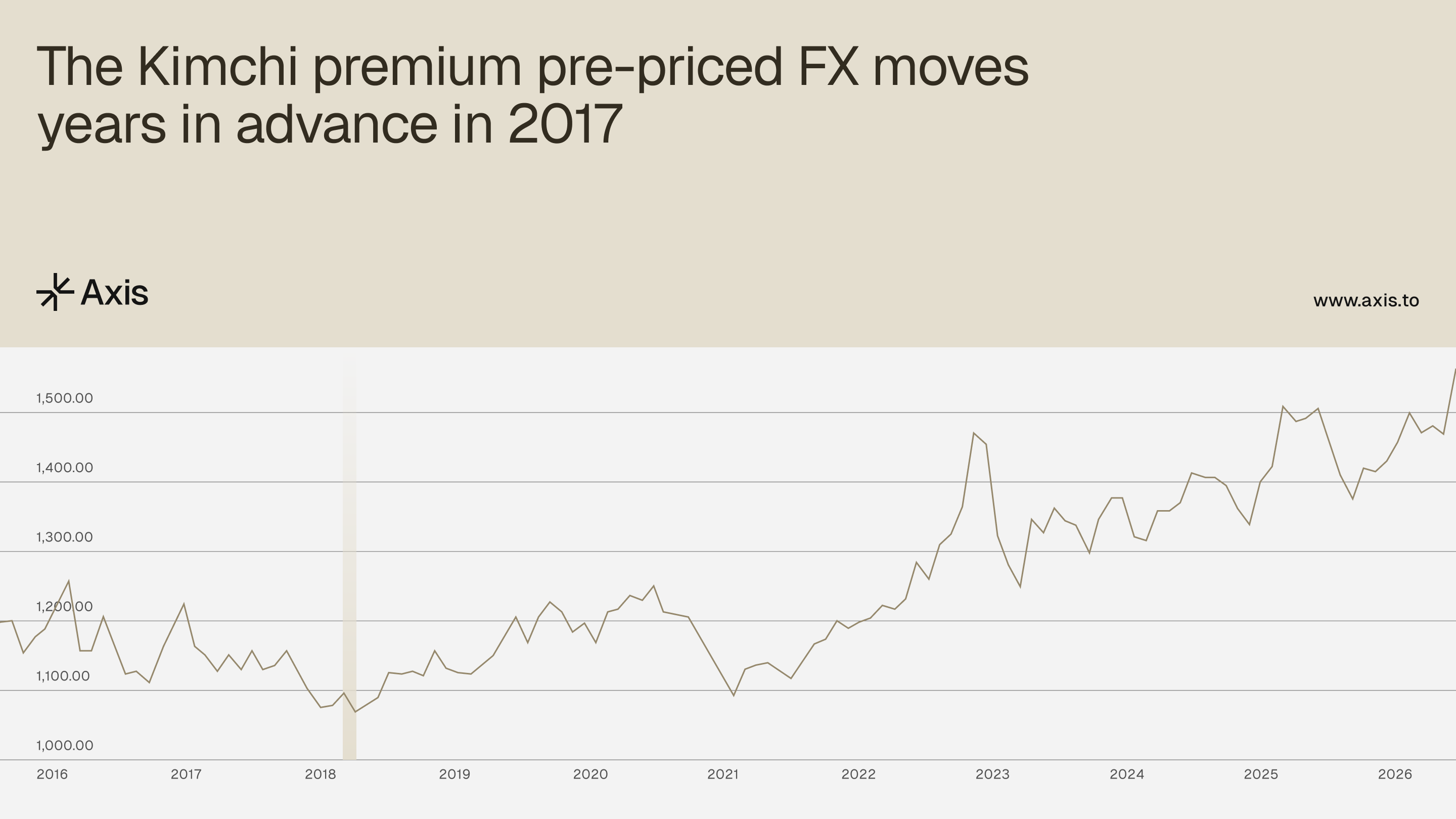
The historical record makes this concrete. Back in 2017, the kimchi premium peaked at around 40% when USDKRW was trading at roughly 1060, implying an effective USDTKRW rate of approximately 1480. Then in December 2024, actual USDKRW crossed 1480. The premium had pre-priced that FX move years in advance, encoded in data that was publicly visible but required a Korean market feed to interpret correctly.
One consistent feature is that the premium does not naturally settle at zero. Research suggests that the premium maintains a structural non-zero floor of approximately 1.24% for Bitcoin as long as capital controls remain in place. This means that wen the premium compresses toward that level, it often reflects a shift in underlying capital pressure rather than a simple normalization.
In 2025, periods where the premium moved toward zero were followed by positive Bitcoin returns over both one-week and one-month horizons, with average BTC returns of 1.7% over seven days and 6.2% over thirty days. For traders, the important signal is less about the absolute level of the kimchi premium and more about how it is changing over time.
The Bithumb Suspension Makes Korean Dislocations Harder to See Coming, and Therefore More Asymmetric
The usefulness of the premium as a signal depends on how price discovery occurs across Korean exchanges. When multiple venues compete to price the same flows, the resulting spread tends to carry more information. As liquidity concentrates, that clarity begins to fade. As a result, the Bithumb suspension is removing the competitive price discovery the premium depends on.
Following the announcement, capital began migrating rapidly toward Upbit, deepening concentration further. In February 2026, a Bithumb operational error that credited 620,000 BTC to users triggered a 17% flash crash in BTC/KRW before prices recovered. That episode illustrated what price discovery looks like when it depends on a single venue operating under stress.
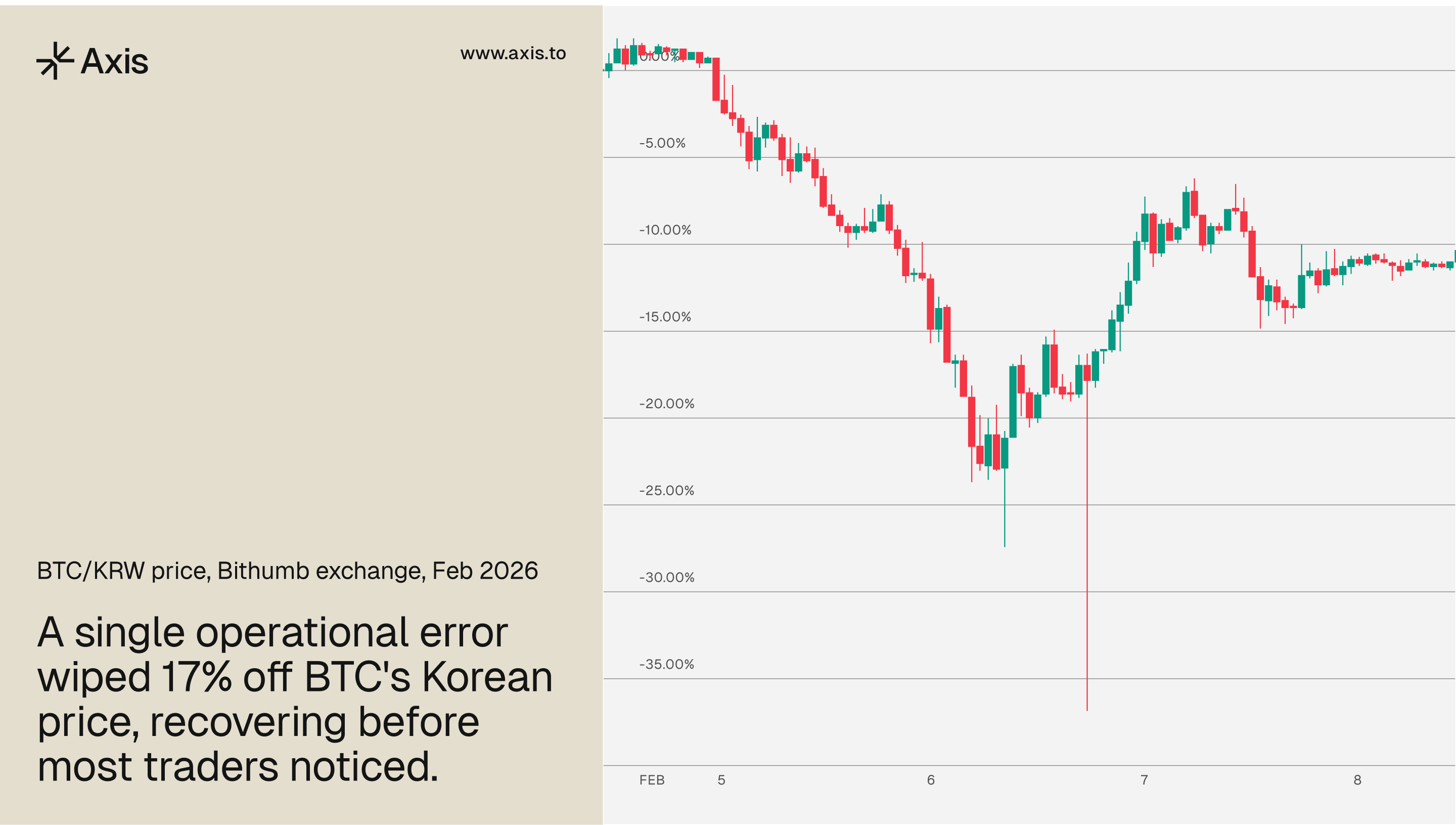
A degraded premium does not mean Korean dislocations stop occurring. It means they become harder to anticipate before they open, widening the information gap between participants monitoring Korean markets directly and those relying on English-language coverage.
The underlying conditions generating these dislocations are also becoming more acute. $110 billion in crypto left Korea in 2025 under strict trading rules. Under the new administration, capital that was structurally pushed out is now being invited back in through new institutional channels, while the exchange infrastructure retail flows depend on is simultaneously being tightened. That kind of policy divergence has historically been the setup for the sharpest and most short-lived dislocations this market produces.
Korean Market Structure Creates Repeatable Information Asymmetry for Global Traders
The kimchi premium is not an isolated quirk of the Korean market. It’s the most widely observed example of a mechanism that operates to some degree in every capital-controlled market where crypto has developed as a parallel financial channel.
The December 2024 martial law event and the Bithumb suspension both illustrate the same dynamic. Dislocations in this market appear quickly, reward participants with the right feed, and close before the rest of the market catches up. The traders who acted on December 3 were not faster or smarter. They were monitoring the right signals and understood how Korean political events map to exchange-level price mechanics before the broader market registered what was happening.
As stablecoin infrastructure deepens globally, more markets will generate the same kind of capital pressure signals Korea has been producing for a decade. The challenge is not identifying that they exist, but building the infrastructure and discipline required to capture them consistently.
Axis Turns Market Dislocations into Actionable Alpha
At Axis, understanding and acting on market dislocations is the foundation of what we do. With 36% annualized returns, a 4.9 Sharpe ratio, and $400 million in peak assets under management, the approach reflects a repeatable process for identifying and acting on pricing gaps as they emerge.
As crypto markets continue to expand across regions with different regulatory and financial constraints, these localized dislocations are likely to remain part of the landscape.
Follow us on X for ongoing analysis of the market structure dynamics that move prices before they show up in the headlines.


